
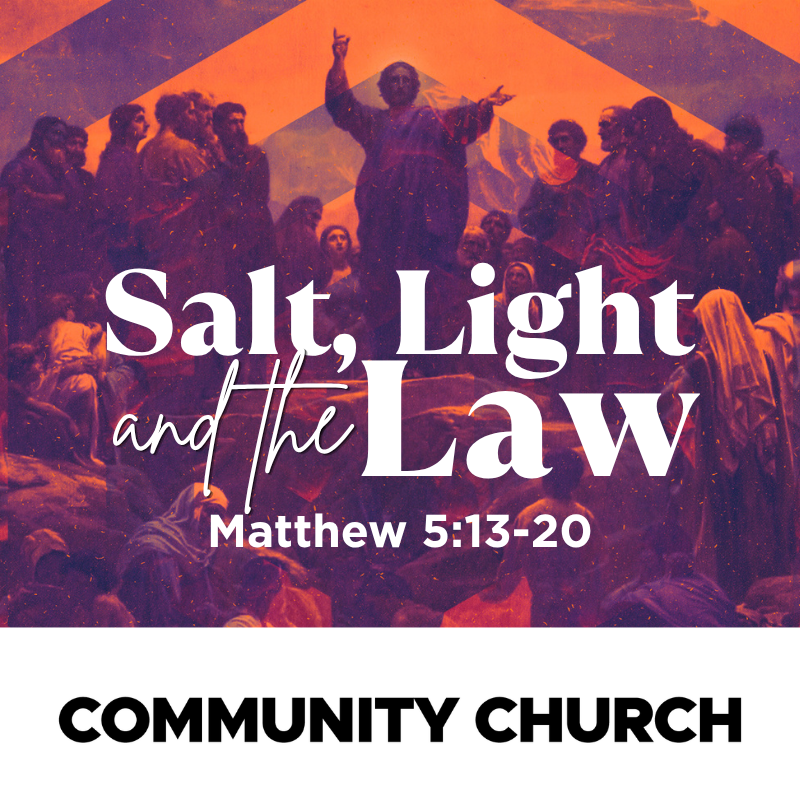
Salt, Light, and the Law
In Matthew 5, Jesus calls His followers the salt of the earth and the light of the world, and these declarations flow directly from the Beatitudes as one continuous thought. Salt in Scripture carried deep meaning, representing covenant, holiness, and permanence before God. Light was the calling of Israel through the prophets, and Jesus now extends that calling to all who follow Him. Just as no one lights a lamp and hides it, believers are called to let their lives shine in ways that point others to God. Jesus also clarifies that He did not come to abolish the Law but to fulfill it, meeting the standard no human could reach. Because He fulfilled every requirement, those who trust in Him are no longer defined by what they could not accomplish on their own. The call to be salt and light is not something we earn. It is something He declared, and we are invited to live it out.
Living In His Presence
In Exodus 33, God offered the Israelites the promised land but said He would not travel with them. Moses, standing in the middle of the wilderness with nothing, made a remarkable choice: he refused the promise without the presence. His response reveals a posture every believer should consider. It is possible to receive everything God promised and still miss what matters most. The favor of God is not something we manufacture through achievement or ambition. It is something we receive when we stay close to Him. The goal was never the destination. It was always the journey with Him.

You Might Be Worshiping God In The Wrong Place
Jacob's story in Genesis 35 is a mirror for anyone who has ever felt spiritually stuck or slightly off course. After encountering God at Bethel, Jacob spent years wandering and eventually settled in Shechem, a place that was comfortable but not where God had called him. He was doing the right things in the wrong place. God's call to Jacob was simple and direct: get up, go to Bethel, and build an altar. The same invitation stands for us today. Wherever you have settled for good enough, God is calling you one step further. You do not have to have it all together to take that step. You just have to be willing.

Philemon Part 2: That Was God
Life rarely goes according to plan, but the Book of Philemon reminds us that our detours are not accidents. Onesimus, a runaway slave, ended up in the same prison as the Apostle Paul, the closest friend of his master, and that unlikely encounter changed everything. God used a desperate decision to bring Onesimus to the right place at the right time, where he heard the gospel and was transformed. Just as Jesus stepped in to pay a debt we could never repay, Paul interceded for Onesimus and called Philemon to extend the same grace he had received. What feels like a failure or a wrong turn may actually be God redirecting you toward something greater. The detour you are in right now may not be a punishment. It may be an invitation to know Him more deeply than ever before.



Philemon Part 1: He Came Back Different
The Book of Philemon is only 25 verses long, but it carries one of the most practical and personal messages in all of Scripture. It tells the story of Paul, a man named Philemon, and a runaway slave named Onesimus who encountered the gospel and was genuinely transformed. Paul appeals to Philemon not with authority, but with love, asking him to receive Onesimus back as a brother rather than a slave. This letter reminds us that faith is not just for Sunday. It has to show up in our everyday relationships, especially the difficult ones. How we treat one another matters just as much as how we worship God. Forgiveness is not a feeling we wait for. It is a choice we make, and sometimes it is a choice we have to keep making. If there is someone in your life who needs grace extended to them, remember that Christ extended it to you first.




Kingdom Manifesto: The Beatitudes — Part 7 — Blessed Are The Peacemakers
In a world that constantly promises peace but fails to deliver, Jesus offers something radically different. The seventh Beatitude reveals a profound truth about peace that challenges our understanding and calls us to a higher purpose.
What Does It Mean to Be a Peacemaker?
"'Blessed are the peacemakers, for they will be called children of God.'" - Matthew 5:9 New Living Translation (NLT)
The Beatitudes present us with characteristics that most people don't aspire to - being poor, mourning, or meek. But here we find something everyone wants: peace. Yet Jesus doesn't call us to be "peacekeepers" but "peacemakers" - and there's a crucial difference.
The World's False Promise of Peace
Our culture constantly offers peace through external means - better jobs, new homes, political solutions, or self-help strategies. Politicians campaign on peace, promising security through various policies. We're told that if we just follow certain steps or acquire certain things, we'll find the tranquility we seek.
Kingdom Manifesto: The Beatitudes — Part 6 — Blessed Are The Pure of Heart
In the Beatitudes, Jesus presents a revolutionary understanding of spiritual blessing that focuses on internal transformation rather than external religious performance. The declaration that the pure in heart are blessed reveals God's priority on the condition of our inner life over outward appearances. A pure heart represents sincerity, authenticity, and undivided devotion to God, characterized by clean motives free from hidden agendas, freedom from hypocrisy and facades, and a genuine desire to please God above seeking human approval.
The importance of heart purity becomes clear when we understand that God looks at the heart rather than outward appearance, as demonstrated in David's anointing as king. Our heart condition directly determines our conduct, words, and relationships—a bitter heart produces toxicity while a pure heart generates righteousness and peace. Various factors can contaminate our hearts, including sin, unforgiveness, pride, worldliness, and hypocrisy, as seen in biblical examples like King Saul, Judas, and even Solomon.
Developing a pure heart requires intentional spiritual disciplines: honest self-examination of our motives and patterns, careful guarding of what influences our minds through selective consumption of content, daily repentance that involves genuine turning from sin, cultivating disciplined thoughts through prayer and Scripture, and maintaining connection with godly community for accountability. The ultimate promise for those who pursue heart purity is the ability to see God—not just in eternity but experiencing His presence and recognizing His work in our daily lives, gaining spiritual sight that transforms how we perceive and interact with the world around us.
Kingdom Manifesto: The Beatitudes — Part 5 — Blessed Are The Merciful
When we read Matthew 5:7, "'God blesses those who are merciful, for they will be shown mercy'" (New Living Translation), our first instinct might be to see this as a transaction. We might think we need to show mercy in order to receive mercy from God. But this understanding misses the heart of the Gospel entirely.
The original Greek text reveals something beautiful about this verse. The word translated as "for" doesn't mean "in order to" - it means "because." This completely changes our understanding. Jesus isn't saying we must be merciful to earn God's mercy. He's saying we are merciful because we have already received God's mercy.
Kingdom Manifesto: The Beatitudes — Part 4 — What Are You Hungry For?
Jesus declares that those who hunger and thirst for righteousness are blessed because they will be filled. This spiritual hunger isn't a burden but a sign of spiritual life and God's ongoing work in us. Unlike the first three Beatitudes that address circumstances beyond our control, this one calls for active pursuit of right standing with God and justice for others. The danger lies in becoming spiritually lukewarm like the church in Laodicea, satisfied with material success but lacking genuine spiritual hunger. True satisfaction comes not from our efforts but from God Himself, who promises to fill those who desperately seek Him.

You’re Not Barren, You’re Next
Hannah's story begins with a complex family dynamic. She was one of two wives to Elkanah, but unlike Peninnah who had children, Hannah remained childless. Despite this, Elkanah showed Hannah special favor, giving her the choice portion during their annual worship trips.
This created an interesting tension: Peninnah had the visible evidence of God's blessing through her children, while Hannah had her husband's love but nothing to show for it publicly. During their worship gatherings, Elkanah would distribute the sacrificial meal, giving Hannah extra portions in front of everyone - a public display of his favor toward her.
Kingdom Manifesto: The Beatitudes — Part 2 — Met
Jesus declares that God blesses those who mourn, which seems counterintuitive but reveals a profound truth about how God works in our darkest moments. Grief is not a sign of weak faith but simply how God designed us to respond to deep hurt. Jesus himself was described as a man familiar with sorrow, experiencing rejection, loss, and pain throughout his earthly life. The blessing isn't found in mourning itself, but in what happens during our grief - God meets us there. When Jesus encountered the grief of Mary and Martha over Lazarus's death, he didn't scold them or rush to the miracle; he wept with them first. God promises to send the Holy Spirit as our Comforter, one who walks alongside us in our pain, offering the comfort we need exactly when we need it
Kingdom Manifesto: The Beatitudes — Part 1 — Bankrupt and Chosen
Jesus begins His most famous teaching with words that seem completely backwards to our modern mindset: God blesses those who are poor in spirit. In a culture that celebrates success and achievement, this opening statement is jarring and confusing. The Greek word Jesus uses, 'ptochos,' doesn't describe someone having financial difficulties but rather someone who has been reduced to begging - a person with absolutely nothing left.
Jesus illustrates this concept through the image of empty hands versus full hands. Many people approach God like a successful CEO rushing to catch a flight, carrying their spiritual résumés filled with church attendance, good deeds, and biblical knowledge. But God responds the same way an airline agent would to someone trying to board a full flight: accomplishments and receipts don't guarantee entrance. Only those who come with empty hands can receive what God offers.
This teaching isn't about having low self-worth or being worthless. Being poor in spirit means showing up before God with the understanding that we've earned nothing through our striving and religious activity. Jesus Himself exemplified this attitude when He emptied Himself of His divine privileges and became completely dependent on the Father. The kingdom of heaven belongs immediately to those who acknowledge their complete need for God, not as something to work toward but as a present reality to receive.

He Is Not Done | John 21:1-21
When life becomes overwhelming, our natural tendency is to retreat to familiar territory, just like Peter did when he returned to fishing after Jesus' crucifixion. In John 21, we see Jesus meeting Peter on the shoreline, asking simple questions that reveal our need for Him. Jesus doesn't wait for us to get our lives together before He approaches us - He meets us exactly where we are, in our uncertainty and struggle. Even when Peter could only offer conditional love instead of unconditional devotion, Jesus still commissioned him to feed His sheep. The Christian journey isn't about going backward to what feels safe, but trusting God to expand our capacity for the greater things He's calling us toward.